Showing posts with label Research - Institution. Show all posts

Saturday, 29 October 2016

Lip syncing

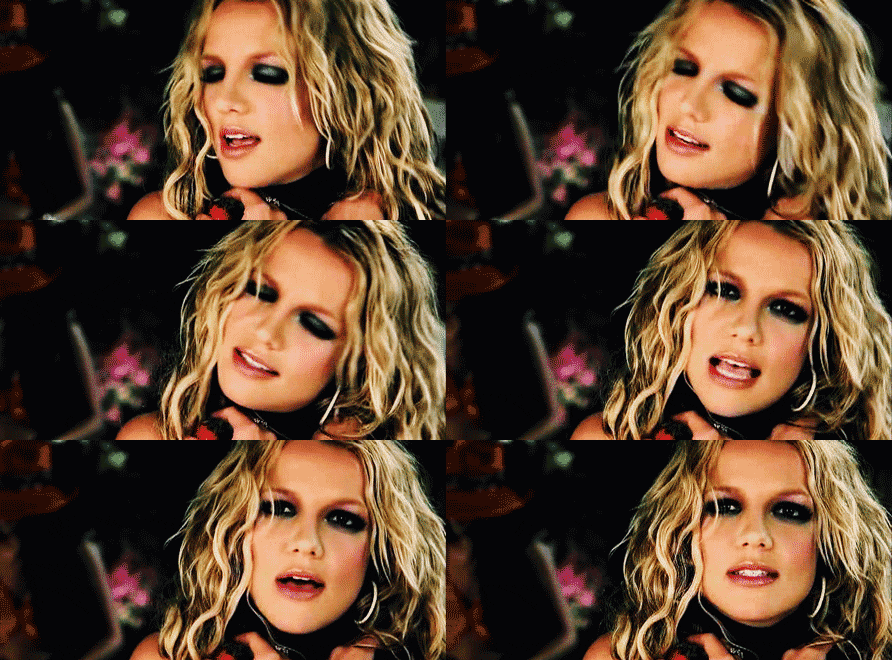
Lip sync (short for lip synchronization) is a technical term for matching a speaking or singing person's lip movements with prerecorded sung or spoken vocals that listeners hear, either through the sound reinforcement system in a live performance or via television, computer or cinema speakers in other cases. The term can refer to any of a number of different techniques and processes, in the context of live performances and audiovisual recordings.

Image result for britney spears singing gif

Image result for justin bieber music video gif gif

Image result for demi lovato gif singing


Monday, 19 September 2016

Other record labels

 Capitol Records (France's old record label)


Image result for capitol record label

Capitol Records, LLC (also referred to simply as Capitol and Hollywood and Vine) is an American record label part of the Capitol Music Group and a wholly owned division of Universal Music Group (UMG). The label was founded as the first West Coast-based record label in the United States in 1942 by three industry insiders named Johnny Mercer, Buddy DeSylva and Glenn Wallichs. In 1955, the label was acquired by the British music conglomerate EMI as its North American subsidiary.[1] EMI was later acquired by Universal Music Group in 2012 and was merged with the company in 2013, making Capitol Records and the Capitol Music Group both a part of the Universal Music Group. Capitol Records' circular headquarter building located in Los Angeles is a recognized landmark of California.


Permission from artist/ record label

To create a music video to a song which is not your own you need to either get permission from the artist, composers, lyricists and music publishers. The reason is because it will be seen as breaking the copyright rules and is known as plagiarism as you do not have or own any rights over the music.

Frances is under the record label Communion.
Communion Music is an independent music company, made up of Communion Records, Communion Presents, and Communion Publishing. It has offices in London and Brooklyn, NY. In its capacity as a label, promoter and publisher it currently works with a wide range of artists including Catfish and the Bottlemen, Ben Howard, James Bay, George Ezra, Bear's Den, Nathaniel Ratefliff and the Night Sweats, Daughter and Highly Suspect.

http://www.communionmusic.co.uk/ 


On the 15th September 2016 I contacted Helen from Communion records seeking her permission to use the song Set Sail by Frances. In the formal email I mentioned my age, studies and where I came from as I found out from research Frances also grew up in Berskire.

"Hi, 
 My name is Danielle. I'm a 17 year student who is currently studying Media studies at Newlands Girls School in Berkshire. For my A2 media project I have to create a music video promo which I am seeking permission from you to do so. 
The Artist under your Label who I'd like to use is Frances with the chosen song of 'Set Sail'.
Frances is one of my favourite singers and I'd be so grateful for your approval of the song for my project as its for an educational purpose. The final product will be put onto YouTube under our school's account, Newlandsmediastudies. It will also benefit other students with their studies for future inspiration when creating a music video.
I have the best intentions to promote your music!"

Thank you for your time
Danielle Whitelaw

As we didn't get a reply we decided to contact the singer directly through her twitter account.


"Hi,My name is Danielle. I'm a 17 year student who is currently studying Media studies at Newlands Girls School in Berkshire. For my A2 media project I have to create a music video promo which I am seeking permission from you to do so. 
I would like to use your song Set Sail.
You are one of my favourite singers and I'd be so grateful for your approval of the song for my project as its for an educational purpose. The final product will be put onto YouTube under our school's account, Newlandsmediastudies. It will also benefit other students with their studies for future inspiration when creating a music video.
I have the best intentions to promote your music!"
Thank you for your time
Danielle Whitelaw."

Record labels

What is a record label? (Wikipedia)

A record label or record company is a brand or trademark associated with the marketing of music recordings and music videos. Often, a record label is also a publishing company that manages such brands and trademarks, coordinates the production, manufacture, distribution, marketing, promotion, and enforcement of copyright for sound recordings and music videos; conducts talent scouting and development of new artists ("artists and repertoire" or "A&R"); and maintains contracts with recording artists and their managers. The term "record label" derives from the circular label in the center of a vinyl record which prominently displays the manufacturer's name, along with other information.
Within the mainstream music industry, recording artists have traditionally been reliant upon record labels to broaden their consumer base, market their albums, and be both promoted and heard on music streaming services, radio, and television. Record labels provide publicists, who assist performers in gaining positive media coverage, and arrange for their merchandise to be available via stores and other media outlets.
However an increasing number of artists have sought to avoid costs and gain new audiences via the Internet, often with the help of videos. Combined with the decline in album sales and rapid growth in free content available online, this has changed the way industry works dramatically since the beginning of the 21st century. It has caused record labels to seek new sources of profit, in particular via "360" deals (see below under "new label strategies").
Record companies and music publishers that are not under the control of the big three are generally considered to be independent (indie), even if they are large corporations with complex structures. The term indie label is sometimes used to refer to only those independent labels that adhere to independent criteria of corporate structure and size, and some consider an indie label to be almost any label that releases non-mainstream music, regardless of its corporate structure.
Independent labels are often considered more artist-friendly. Though they may have less financial clout, indie labels typically offer larger artist royalty with 50% profit-share agreement, aka 50-50 deal, not uncommon.
Major record labels
Image result for major record labels

Monday, 12 September 2016

Forms of a music video

Narrative - A video that features a visual story that is easy to follow. Narrative music videos can also use diegetic sound, particularly if there is dialog between a few characters.

Concept - Concept videos are usually based around a single idea or concept and are often unusual or even surreal for the audience. This unusual content often draws the audience in and is attractive to them. They often have no storyline and sometimes no relation to the lyrics of the music itself.

Performance - A performance based video shows the artist/ band/ group performance throughout the song and sometimes can play throughout the whole video. This type of video is good to use on a low budget.

Sunday, 11 September 2016

The purpose and conventions of promotional music videos

Music videos were originally made as marketing devices intended to promote the sale of recordings, which are also known as "Promo's".

Nowadays nearly every song which makes it into the charts are accompanied by a music video. It would be abnormal if they didn't as it is now a commonplace in time to have one. music videos are made to promote the song meaning if the video is good it can boost the popularity, sending the song into the top 10! which also tends to promote the artists album too. Sometimes the decision to make a music video can be decided well after the release of the song, which is a well known strategy of self-promotion from the artist/band of making their song popular again.
Artists can be known and referred to purely for their memorable music videos such as Britney Spears- ...Baby One More Time, Spice Girls- Wanna Be and Wheatus- Teenage Dirtbag etc.

The purpose of a music video is to:
- Sell the song, and invoke a reaction so that the audience remembers the song
- To give the audience a better understanding of the song
- To entertain and show off the artists talents
- To sell CD's, DVD's and downloads by creating memorable visuals 
- Marketing for the purposes of exposure and expansion of the artist's profile
However, the overall purpose of any music video is to help generate money for the record company!

When making a music video there are certain guides you need to follow to let the consumers understand the meaning behind it and make them want to watch it on endless repeat. Promotional videos are very structured on the organisation of how to put one together:
Step 1- Strategic Planning:
Identifying purpose and strategic goals to the story.
Creative brief, story outline, goals, genre, budget (decision made between the production company and client), audience, script, storyboard, etc.
Step 2- Pre-Production:
Planning the technical aspects to creating and filming the video
Step 3- Production:
The actual days of the video shoot while on set or on location
Step 4- Post-Production:
Putting the video together through editing and fine-tuning the visuals and sound
Step 5- Distribution and marketing:
Distribution, promotions, media, video search- engine-optimizations and sharing

Andrew Goodwin's Categorisations and features of music videos
Goodwin's theory states that there are 5 key aspects to a music video that the audience should look out for
- Thought through beat (seeing what the lyrics means in your head)
- Relationship between the song and visuals
- Narrative and performance of the song
- Star image
- Technical aspect of a music video

Thought through beat (seeing what the lyrics mean in your head)
The first step of this process is to analyse the music structure and how we take it into account from the sound of understanding the chorus and verses.
The next step is the main voice of the song. The voice of the song would be extremely unique and can form identification or trademarks that work well with the star image or singer.
Roland Barthes theory of the Grain of voice can be related to this as he sees the singing voice as an expressive instrument and therefore able to make associations of its own.
Thirdly, Goodwin points out the artists mode of address. Songs can be seen as stories, who the artist is the story teller making the music video a two communication device, them telling us a story and us listening.

Relation between the music and visuals 
There are three ways the visuals are used to promote a song:
Illustrate - Music videos can use certain images and shots to illustrate/ explain the meaning of lyrics to their song and genre.
Disjuncture - This is where the meaning of the song is completely ignored in the music video.
Amplify - similarly to repeatability this is when the image and camera shots are manipulated and shown repeatedly throughout the music video and is drummed into our vision.

Andrew believed that a music video can promote a song by though the way it analysis the lyrics. This is shown in many music videos when a character does exactly what the song says.

Narrative and performance of the song
Andrew Goodwin believed that it was important for an artist to be involved in the music video by performing or acting out a role as the main character or singer.
It helps to make the song look more realistic and also giving the audience a special connecting and a good understanding of the song which will make the audience be able to watch the video over and over without loosing interest.

Star image 
Goodwin referred to the star image as a vital aspect of the music video. Meta narrative which is a big story that describes the development of the star over time, it has an important part to play in the music video production process.

Technical aspect of a music video
Technical aspects hold the music video together through use of camera work, movement, angle, Mise-en-Scene editing, sound and special effects.
Speed, camera movement, editing, cutting and post production are all forms of use of camera.
Lighting and colour help set moods and emphasise key movements of the song for dramatic effect.
Mise-en-Scene, the setting of the music video is vital, it needs to look authentic to attain professionalism.
Beats, music videos use cuts to go with the beat or rhythm making the video more entertaining.

Digipacks
what are digipaks?
Digipaks are a type of packaging for CD's or DVD's made from cardboard with an internal plastic holder for one or more discs.
When digipaks were first created they were origianlly seen to be as limited edition or specialist CD products however improvements in CD production, packaging and printing techniques has meant that digipaks are now available at much lower prices.
There are lots of different finishes between each possible digipak such as matte lamination, spot UV, embossing etc. CD digipaks are most popular in the music industry as it gives the product an expensive professional look and feel. The artwork of digipaks ranges between each artist as they tend to make it unique to fit in with their genre of music and the consumers.


The most common digipaks are normally the 4 panel which opens like a book, however 6 panel CD digipaks are also very popular, providing a larger canvas for CD artwork and text information about the CD.
'Green' digipak.
As environmental concerns have become a priority for some consumers, businesses and governments alike only use sustainable material for the cardboard stock, as well as offering a recycled card stock solution too.
'Greener' digipak.
A paperfoam tray for the digipak can also be offered which replaces the plastic flexitrays with 100% biodegradable tray made completed out of natural resources.

Examples of digipak templates:

4 Panel CD DigiPak with Slit-Cut TemplateStandard 4 Panel CD DigiPak Template


4 Panel CD DigiPak with Diagonal Pocket Template4 Panel CD DigiPak with Glued Booklet Template


4 Panel 2 Tray CD DigiPak Template
4 Panel CD DigiPak with Outer Thumbcut Pocket Template


Magazine advertisement
Although magazine advertisement isn't as popular as it use to be dropping from $23.7 billion to $19.5 billion from 2009-2010 its still a key promotional tool to get an artists music to be advertised.
The benefits of magazine printing allow the consumers to see a clear picture of the product and to be informed of the release date, it also advertisers to people who may not of heard of the artist/band before. With magazine advertisements you are almost guaranteed to reach your intended audience. The time the magazine goes out with the advertisement is vital as you need to put it out before the release to get the audience excited, however you don't want to put it out too much before the release date as the consumer may forget about it. Advertisement normally starts around 1-6 months beforehand.